In March 2020, the South American subcontinent was the first region of the world to adapt its harvest to the conditions imposed by the COVID-19 pandemic. In 2021 the same rules still apply. One of the geographical features of Latin America is that most of its olive groves lie outside the “Mediterranean latitude”, between 30 and 40 degrees North.

Northernmost
areas
The northernmost production areas are in Colombia, in Leyva, province of Boyacá, at 2,200 metres of altitude and +5 degrees of latitude, and in Peru, in the Ica region, at 14.5 degrees South.
The southernmost area is in Argentina, in the province of Chubut, at −42 degrees of latitude. The 2021 harvest is a “high” production cycle, which should reach 60,000 tonnes, 20 % more than in 2020.

In Argentina
Argentina is the largest olive oil producer of the Americas and one of the ten largest in the world. It started its 2021 harvest at the end of April and should finish in July. Harvests vary widely from one region to another; San Juan, in the north-west, is one of the leading provinces.

Agricultural
development
Over the last twenty years, Argentina has made great progress in its olive growing expertise and has adapted to very different climates to get the best yield and sensory quality, for example with new regions with maritime microclimates in Patagonia.

In Chile
25,000 hectares of plantations, with an average production of 20 to 22,000 tonnes of olive oil. Most groves are super-intensive, giving Chile the title of the most efficient producing country in the world (nearly one tonne of oil per hectare).
In Peru
Gianfranco Vargas Flores, olive consultant and master miller, confirms a harvest well below that of 2020, with 180 tonnes of olives for the whole country. Table olive exports will also be lower than last year.
In Uruguay
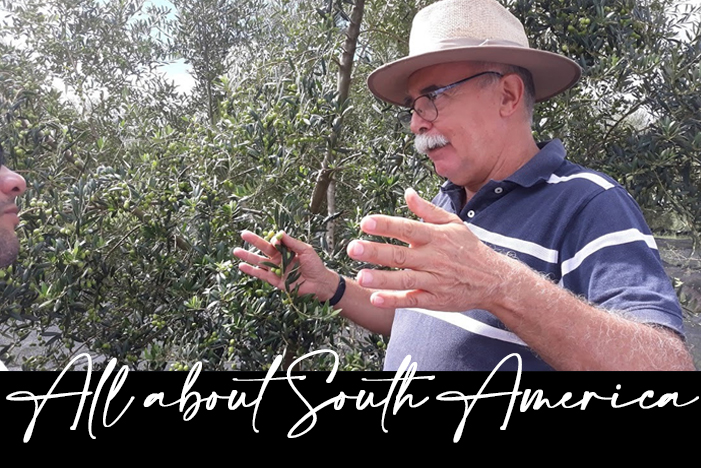
Gonzalo Aguirre is a producer in the north-east of Uruguay. His farm combines livestock, forestry and olive growing. The olive grove covers 95 hectares with Arbequina, Coratina, Picual, Hojiblanca and Manzanilla, planted in stages since 2012.

In Brazil
The youngest olive growing country of the subcontinent started to develop intensively in 2010. There are now 6,500 hectares planted in the states of Bahia, Espírito Santo, Minas Gerais, São Paulo, Paraná, Santa Catarina and Rio Grande do Sul.